


This post is brought to you by Steel and Stone by M. D. Jackson. This novel is made up of three parts, “Rolling Stone” which appeared in Ships of Steel last year, plus two further adventures about Stone the secret agent working with Marella, a woman he saves from invisible foes aboard a spaceliner. Later stories feature Steel’s ship Darlin’ (Darling Buds of May), a killerbot like you’ve never experienced before, as well as Marella’s adventure aboard a Niven Ring at the edge of the galaxy. All three parts combine to make a Space Adventure novel that will keep you turning pages!
Bertrand l. Shurtleff (1897-1967) was a man who had no need to write a single word about Science Fiction at all. He was already famous as a wrestler and football player and could naturally have spent his entire career writing about sports or war. He served in the Navy in WWI. (His novels feature either military, dogs or sports themes.) But he didn’t, instead he wrote for adventure, detective and sports Pulps as well as Science Fiction. Shurtleff”s name adorned such magazines as Short Stories, Popular Detective, Street & Smith’s Sport Story, Frontier Stories, Sky Riders and many issues of Argosy.
Here was a man looking for new challenges from many genres. His Science Fiction starts in Argosy then moves to F. O’Connor Sloane’s Amazing Stories then Ray A. Palmer’s Amazing Stories and Fantastic Adventures and finally in John W. Campbell’s Astounding Science-Fiction. Peppered around these are off-trail pieces for The Golden Fleece, Doc Savage and The Phantom Detective, all detective/adventure magazines. (Unfortunately the restrictive copyright of Doc Savage Magazine, which reprints the novels endlessly, has left the back-up fiction in limbo. We won’t be able to look at those tales in any detail.)
1920s

“Menacing Shadows” (Argosy All-Story Weekly, April 27, 1929) has a mysterious force that jams all the radios and destroys warships. It is up to Ross, the radio President’s trouble-shooter, to solve the case. The culprit proves to be Fu Manchu wannabe Soon Fang.
1930s

“North of Matto Grosso” (Amazing Stories, July 1932) shows Shurtleff’s military background. After World War I, our heroes Bill and Ed take on Killer Stein, a terror from the war. They sneak into his secret jungle territory where he keeps scientists captive to create new weapons. Stein also has Bill’s girl. The men get caught and escape over and over until they get staked out in an arena, surrounded by the local Indians. A handy-dandy concealed laser takes out the bad guys. E. F. Bleiler in Science Fiction: The Gernsback Years (1998) summed it up with “Pretty bad”.

“Death Under Forty” (The Phantom Detective, April 1937)

“Man Without Meat” (Doc Savage Magazine, June 1937)


“Whales’ Way” (Golden Fleece, October 1938) is lengthy novella from a historical adventure magazine that follows whalers in the tropics. The fantastic element is slight in the form of the Whale Man who can summon whales.


“The Underground City” (Amazing Stories, September 1939) begins with miners disappearing before it is discovered that an underground civilization has taken them for slaves. Pretty standard Ray Palmer stuff.
1940s

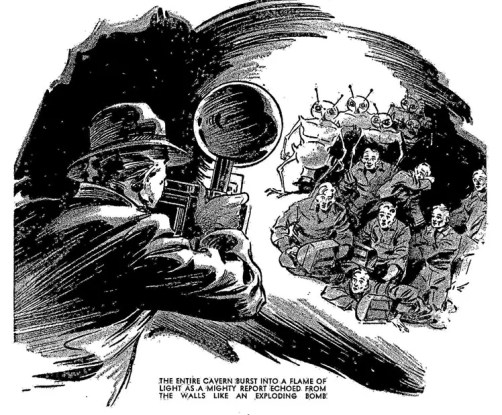
“New York Fights the Termites” (Fantastic Adventures, February 1940) has the Termanites, giant termites attacking New York’s subway. The trapped travelers are saved by a newspaperman. For more on this story, go here.


“Silence Is Deadly” (Astounding Science-Fiction, April 1942) should be Shurtleff’s masterpiece, selling to the King of Editors, John W. Campbell, but it is more of a re-write job. For this one Shurtleff returns to Radio and the Navy. Like “Menacing Shadows” we have a device that can jam radios. Another detective must solve the case. Unlike many of the Golden Age tales, this one hasn’t been reprinted. This maybe partly because the story’s appeal was of the time it was published. During WWII, worries about secret advances in technology seemed more plausible. Mad scientist just never seem to go away though.

“Whales Don’t Scare” (Doc Savage, November 1944)
Conclusion
Bert Shurtleff may not have been a great Science Fiction writer. He certainly wasn’t an innovator. But what he does get credit for is attempting to write outside the safe genres of Sports and Aviation. Occasionally Pulpsters would write a tale they couldn’t sell to their regular markets because it was too off-trail or too horrific. These tended to end up in Weird Tales or Amazing Stories. (Argosy published plenty of Science Fiction but they didn’t take everything.)
Bert Shurtleff may not have been one of these, finding a quick market for a dud. He may have sought out editors like Sloane and Palmer. After 1944, he returned to Short Stories and Adventure and later to further book publication. Science Fiction was just a break for him. Dipping in and out usually doesn’t produce masterpieces but sometimes we get lucky with writers like T. S. Stribling and E. M. Forster. Shurtleff, not so much.
Discover these RAGE m a c h i n e SF books


