


This post is brought to you by the upcoming Steel and Stone by M. D. Jackson. This novel is made up of three parts, “Rolling Stone” which appeared in Ships of Steel last year, plus two further adventures about Stone the secret agent working with Marella, a woman he saves from invisible foes aboard a spaceliner. Later stories feature Steel’s ship Darlin’ (Darling Buds of May), a killerbot like you’ve never experienced before, as well as Marella’s adventure aboard a Niven Ring at the edge of the galaxy. All three parts combine to make a Space Adventure novel that will keep you turning pages!
Comics have been using Science Fiction ideas from the beginning. Superman was influenced by the Pulps from Doc Savage to Philip Wylie. “That Buck Rogers Stuff” of the comic strips easily found a second life in comic books, as the strips of Buck, Flash and others were reprinted. So SF and comics pretty much developed together.

Another factor was that the companies that produced Pulps also made the comics. Planet Stories got Planet Comics, for an obvious example. Ned Pines’s Thrilling Pulps got Thrilling Comics, along with Exciting Comics and even Wonder Comics. You get the idea. Science Fiction would always have a home in four colors.
Astounding Stories of Super-Science was born in January 1930 under the editorship of Harry Bates. This first version, known as the Clayton Astounding, was the first SF Pulp to treat Science Fiction as just another Pulp genre. It ended in 1933 when Clayton went under but resurfaced later the same year as a Street & Smith Pulp. The new editor was F. Orlin Tremaine. It is his Astounding Stories and his “thought variant stories” that gives us our first story here. He left in 1938, allowing his assistant John W. Campbell to bring in the Golden Age of Science Fiction and the heydeys of Astounding Science Fiction. That is the period that the rest of these nine stories comes from.


All that being said, actual adaptations of SF stories (with credit) took a while. EC famously stole Ray Bradbury’s stories (as well as others) until Ray called them on it. The company continued with Ray’s blessing (and a pay check.) Adam Link got some too.The next big collection of adaptations (outside the Horror adaptations at Warren) was in the 1970s. Most of these were at Marvel but not all. Marvel added anthology titles in color and black & white with Worlds Unknown and Unknown Worlds of Science Fiction. That Unknown Worlds/Worlds Unknown theme is important as it shows where some of their inspiration came from. The other comic was Starstream, published by Western under the Whitman label, and edited by SF powerhouse Roger Elwood. Elwood published a ton of SF anthologies between 1974-1977 before disappearing into freelancing. That he would be involved in yet another iteration of the SF anthology isn’t really surprising.


“Born of the Sun” (Astounding Stories, March 1934) by Jack Williamson (Starstream #3, 1976) adapted by Ed Summer. This is the oldest story here, with Williamson’s classic planet that hatches plot.


“Who Goes There?” (Astounding Science-Fiction, August 1938) by John W. Campbell as Don A. Stuart (Starstream #1, 1976) adapted by Arnold Drake. Filmed several times from 1951, 1982 to 2011, “Who Goes There?” is set in the Antarctic where a crew of men find a frozen spaceship inhabited by a shape-shifting alien. The original story by Campbell is more of a puzzle tale than a Horror story (like his earlier “Brain-Stealers of Mars”) but John Carpenter’s film version certainly changed that focus. The Starstream comic, which appeared before Carpenter, finds a middle ground.


“Black Destroyer” (Astounding Science-Fiction, July 1939) (Worlds Unknown #5, February 1974) by A. E. van Vogt adapted by Roy Thomas You will notice that The Day of the Triffids was announced for the next issue. This did not happen, but was the opener for Unknown Worlds of Science Fiction issue #1 and 2. As it was not a great adaptation, no loss. This story didn’t get a movie but van Vogt claimed that Alien was based on”Black Destroyer” and its sequel, “Discord in Scarlet”. The movies writers denied the influence but the producer settled and van Vogt got a screen acknowledgement. So, it kinda was filmed…


“Farewell to the Master” (Astounding Science-Fiction, October 1940) by Harry Bates (Worlds Unknown #3, September 1973) adapted by Roy Thomas. Another story that inspired a famous movie or two, The Day the Earth Stood Still is the more familiar title, both 1951 and 2008. The author is Harry Bates, who started as editor of the Clayton Astounding but returned as a writer. The film version makes one crucial departure. It ignores the big reveal at the end of the story, that Gort the robot is the master, not Michael Renee. The comic does not make this change.


“Microcosmic God” (Astounding Science-Fiction, April 1941) by Theodore Sturgeon (Starstream #3, 1976) adapted by Arnold Drake. Talk about talking heads! Charles Schneeman’s illos make it look good but….


“Adam and No Eve” (Astounding Science-Fiction, September 1941) by Alfred Bester (Unknown Worlds of Science Fiction #2, March 1975) is another classic, doing a riff on the awful Adam and Eve cliche. The story was adapted by Denny O’Neil.


“Last Voyage of the Albatross” (aka “Not Only Dead Men”) (Astounding Science-Fiction, November 1942) by A. E. Van Vogt (Starstream #3, 1976) adapted by George Kashdan. Not sure why they changed the title. They did this with Robert Bloch’s “The Fear Planet” too. For more on this story, go here.


“Arena” (Astounding Science Fiction, June 1944) by Fredric Brown Worlds Unknown #4, November 1973) adapted by Gerry Conway. “Arena” got a television version on January 19, 1967 with Captain Kirk and the Gorn duking it out on a hostile planet. The original adaptation by Star Trek was not acknowledged but Gene Roddenberry made the wise decision to pay out royalties. “Fun and Games” (March 30, 1964) of The Outer Limits is considered an earlier and unacknowledged version. Brown’s original has some nice details that TV couldn’t use but the comic comes much closer to, like the surrounding arena dome. Kirk just runs around Death Valley. For more on this story, go here.
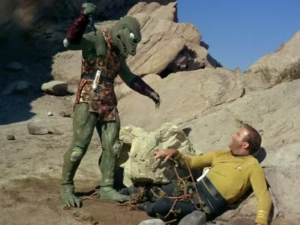


“Killdozer!” (Astounding Science Fiction, November 1944) Worlds Unknown #6, April 1974) by Theodore Sturgeon was adapted by Gerry Conway. The TV movie version from 1974 is pretty hokey, though Clint Walker does a good job of being a tough construction worker. I really liked the preamble in the comic that suggests another world where humans and robots fight for supreme control. Talk about early Terminator!

Conclusion
When choosing a story for adapting, comic writers usually liked a combination of fame and action. “Microcosmic God” by Theodore Sturgeon is a rare case. His “It” was adapted around the same time in Supernatural Chillers #1 and is a much more interesting comic. This action element was also what made the ideas good for Hollywood. Science Fiction movies do better at the box office when they aren’t too “thinky”. A film like Gattaca (1997) gets label “dull” when it is actually pretty cool. This trend should be even stronger in comic books, which have been dominated in America by superhero punch-ups for decades. It’s not hard to find SF original ideas in other comics, for instance the entire X-Men franchise begins with A. E. van Vogt’s Slan from Astounding, but actual, acknowledged adaptations are harder to find.
Next time…More Pulps and Digests into Comics
Discover these RAGE m a c h i n e SF books


Ah, memories. A number of those Marvel adaptations ended up filling out the back pages of the UK version of Planet of the Apes, in black and white. It was mind-expanding science fiction for ten-year-old me.
Living in Canada, I go the color US version, of course. I do have those UK black & whites though. They go so nicely with the 2000 A. D.s.